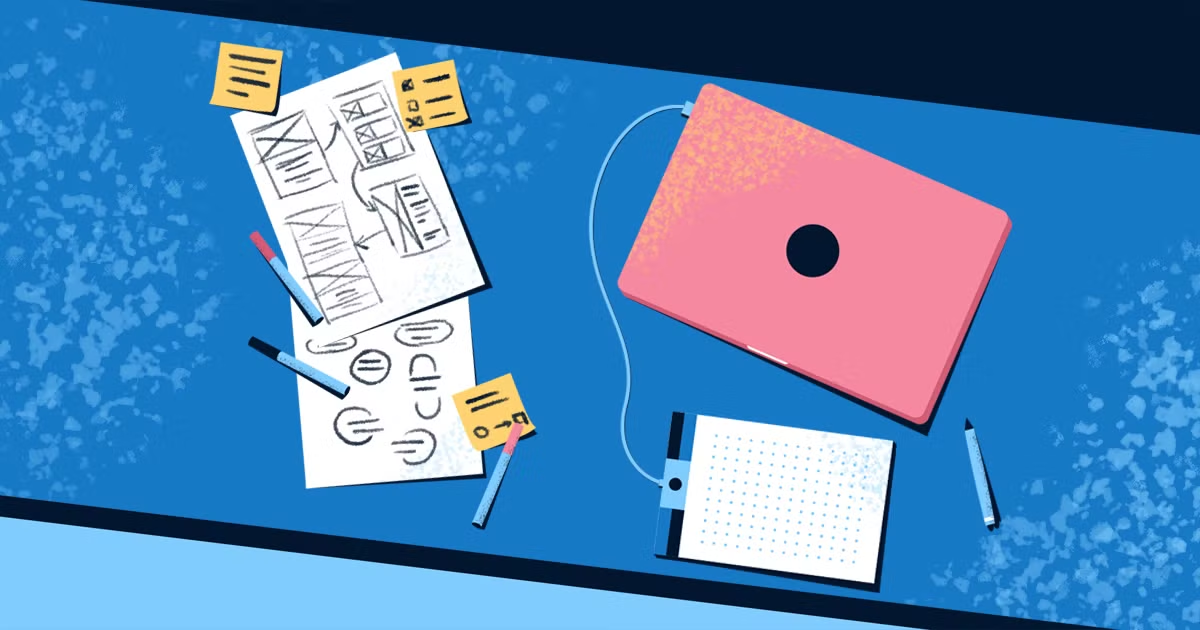
There is a version of the design process that lives in case studies and portfolio decks: a clean arc from research to concept to refined final output. The arrows point in one direction. Each phase flows neatly into the next. It looks organized and deliberate, because by the time anyone writes it up, they have had time to retroactively impose that shape on what happened.
The reality is different. Not chaotic — but nonlinear in ways that matter. Understanding what design actually looks like, from the inside, can help clients work with studios more effectively and help designers set realistic expectations at the start of a project.
The Brief Is a Starting Point, Not a Destination
Most projects begin with a brief. Sometimes it comes from the client in a detailed document; sometimes it emerges from an initial conversation. Either way, the brief you start with is almost never the one you finish with.
This is not because clients don't know what they want. It is because knowing what you want requires having thought through options, trade-offs, and implications — and most people haven't done that kind of thinking before the design process starts. That's what the process is for.
A good brief is like a good first draft: it is necessary, useful, and almost certainly incomplete. The designer's job in the early stages is to take that starting point seriously while staying alert to what it doesn't yet capture.
We have worked on projects where the brief said "update our logo" and the real need turned out to be a complete rethinking of how the organization communicates its identity. We've also worked on projects where "brand overhaul" was actually "help us be more consistent with what we already have." Neither brief was wrong. They were just the beginning of a longer conversation.
Research: The Slowest Part That Matters Most
Design without research is decoration. That might sound harsh, but the premise is straightforward: if you don't understand the context a design will live in — the audience, the competitive environment, the cultural associations, the practical constraints — then you are making aesthetic decisions in a vacuum. Those decisions might look good in isolation. They often don't perform well in the world.
Research looks different depending on the project. For brand identity work, it might mean competitive landscape analysis, audience interviews, a review of the client's existing communication, and building a clear picture of where there is genuine visual space. For web design, it might mean user interviews, traffic data analysis, heuristic evaluation of the current site, and mapping the key journeys users actually take.
The research phase is often where the brief starts to shift. Something emerges that wasn't in the initial conversation. An assumption gets tested and doesn't hold. A constraint appears that changes the direction significantly. None of this is a problem — it is the point. Better to find these things in week two than in week eight.
Concept Development: The Productive Struggle
This is the phase most clients see the least of, and probably the most misunderstood part of the process. It is also where the real design work happens.
Concept development is not about generating as many ideas as possible and picking the best one. That approach tends to produce ideas that are easily generated — which is to say, ideas that have been done before. Good concept development is slower and more directional. It starts with a design problem and explores different ways of answering it, each grounded in the research and the brief.
It is also not linear. Some directions get explored and abandoned. Some half-formed ideas get set aside and come back two days later in a different shape. Some concepts that look promising in the morning don't hold up by afternoon. This is normal and productive — the exploration is doing work even when it isn't generating output.
The ideas that make it to the final presentation are often the ones that survived the longest — not because they were the first or the most obvious, but because they kept revealing more rather than less the longer you looked at them.
Maya Chen, Folk Heart DesignsWhen we present concepts to clients, we typically show two or three distinct directions — not ten variations of the same idea. Each direction represents a different answer to the design problem. We explain the thinking behind each one clearly, because clients can't evaluate a concept without knowing what it is trying to do.
Feedback: Why It's a Skill
Most clients have not had a lot of practice giving design feedback, and that's fine — it's not something most people do regularly. But it means that feedback sessions are often more valuable when they are structured than when they are open-ended.
Good feedback is specific and connected to purpose. "I don't like how this feels" is a starting point. "This feels too formal for the audience we're talking to" is actionable. The first statement tells us something went wrong. The second one tells us what to fix and why.
Part of our job is to ask questions that help clients get to the second kind of feedback. We find it useful to separate what someone personally prefers from what serves the design purpose. Those aren't always the same thing, and acknowledging that distinction openly makes the feedback process faster and less fraught.
The Refinement Phase: Slower Than It Looks
Once a concept direction is chosen, the refinement phase begins. From the outside, this can seem like a small amount of remaining work — a direction has been set, surely the rest is just finishing up. In practice, refinement is often as time-intensive as the earlier phases.
This is where decisions get made at every level of detail: the exact weight of a letterform, the spacing between elements in a composition, the precise shade of a secondary color, the interaction state of a button in a digital product. These are not small decisions — they accumulate into the difference between work that feels finished and work that doesn't.
Refinement also involves testing. For digital work, that might mean usability testing with real users. For identity work, it might mean seeing how the system holds together across different applications. Either way, refinement is not polishing a complete design — it is continuing to make decisions, just at a finer level of resolution.
Documentation: Making the Work Last
The deliverable is not just the finished design — it is the design plus the documentation that lets others use and extend it correctly. This is where a lot of studios fall short, and where a lot of clients end up struggling after a project ends.
Good documentation covers not just what the design is, but why decisions were made and how to apply the system to new situations. It is practical, not comprehensive for its own sake. The test of good documentation is whether someone who wasn't in the design process can use it without having to call the studio.
What to Take From This
If you're working with a design studio — or planning to — understanding the actual shape of the process helps set realistic expectations on both sides. Projects are not linear. The brief will evolve. Feedback rounds are where some of the most valuable work happens. Refinement takes time. Documentation is part of the work, not an optional add-on.
The studios and clients who do the best work together tend to be the ones who approach the process as a genuine collaboration rather than a transaction. The client's job is not just to approve things — it is to bring the knowledge about their business, audience, and context that the studio can't have without them. The studio's job is not just to execute — it is to make design decisions the client couldn't make on their own.
When that kind of collaboration actually works, the result is work that is better than either party could have produced separately. That's what the process is ultimately for.